




A plumber with only 12 reviews is outranking a competitor with 2,800 reviews in Houston right now.
How?
By using this simple Google Maps ranking system that takes just 30 minutes to set up with AI.
Most local business owners think more reviews equals higher rankings. But I’m about to show you why that’s completely wrong and what actually gets you to rank number one on Google Maps.
In this comprehensive guide, I’m going to show you how to get to number one on Google Maps in just 30 days. Even if you’re brand new to SEO, you’re going to discover:
- How to properly set up your Google Business Profile to outrank competitors, even if they have 10 times more reviews than you do
- The exact website structure that Google awards for local rankings (spoiler alert: it’s not blogging like so many SEO experts tell you)
- What I found when I analyzed the title tags of 100 local business websites—it’s shocking how easy they’re making it for you to outrank them
- The AI prompts that can do 80% of the work for you, the exact ones that we use at my agency
80,000 Visits But No Local Traffic
Let me start by telling you about a local Chicago business. They’re getting over 80,000 monthly visits from Google search, but almost none of them were local.
At the time, they were following conventional SEO wisdom. They were writing blogs, building backlinks, and sure, they’re getting traffic, but not the kind they wanted.
They owned a LASIK eye surgery center in downtown Chicago, inside the loop. But despite all of that website search traffic, barely any of it was from people who lived in Chicago. Talk about wasted effort.
The Before Picture
Here’s what their local rank position looked like for their target keyword before they implemented this system.
Do you see all those spots with position four or higher?
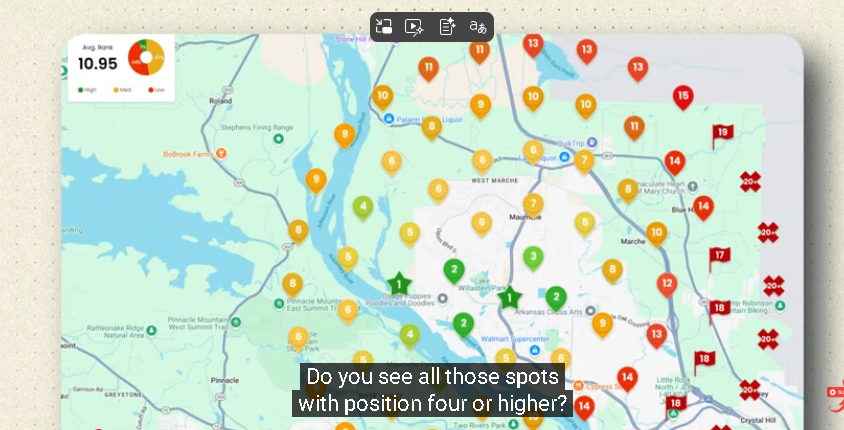
For locals, position four is the first position on the second page, which might as well be invisible. No one goes to page two.
They were ranking out in Lake Michigan for some reason, and a tiny bit close to their address and on the south side, but nothing in the neighborhoods where their customers actually lived.
The Transformation
Their website was completely restructured using the exact system I’m about to share with you. And here’s what that local ranking map looks like now: green dots everywhere. A dramatic improvement in local rankings, and more importantly, a massive increase in calls from actual potential customers in Chicago.
This is why you need a completely different approach for local SEO success, and I’m going to break it down for you step by step.
By the end, you’re going to understand why this system works in over 90% of local markets and why those seemingly successful competitors with thousands of reviews still can’t crack the top three positions.
Google Business Profile Foundation Strategies
Let’s start with the foundation of local SEO success: your Google Business Profile, or GBP.
The Critical Mindset Shift
The first thing that we need to understand is that the goal of any local engagement is to rank the GBP, not the website, not the URLs, but the Google Business Profile itself.
Every URL on a local business website exists to help the GBP rank higher.
This is critical to understand because it will change your entire approach to local SEO. And that is where most local businesses make a massive mistake right from the start.
Category Optimization: Stop Leaving Money on the Table
They choose one primary category like “plumber” and call it a day. But Google allows you to choose up to 10 categories. If you’re only using one, you’re leaving money on the table.
You really should target at least four or five categories on your GBP, not just the primary one.
So if you’re a plumber, you might also add relevant GBP secondary categories like:
- Drainage service
- Gas installation service
- Heating contractor
These work as secondary categories alongside your primary plumber category.
List at Least 30 Services on Your GBP
Next, I want you to list at least 30 services on your GBP. Most local businesses have zero services listed, or maybe just a handful. But by listing 30 or more, you’re telling Google exactly what you do, and for which searches they should show your business.
Now, if you don’t know what services to add, no problem. Here’s a simple AI prompt you can use:
AI Prompt for Services: “You are a local SEO expert. What services should be added to a Google Business Profile for a plumber in Houston? Please be specific and list at least 30 services, but feel free to list additional ones. Each service should have specific offerings and not broad categories. Also include variations of services that might have different names, but are commonly searched for by my target customers.”
Complete Every Single Field
And finally, fill out absolutely every single box in the GBP. Every single box. Your business description, the services that we talked about, the Q&A, the posts, the photos—everything.
The 52-Week Posting Strategy
And speaking of posts, the goal should really be to regularly post on the GBP once a week or so. Schedule 52 posts to go live once a week, and then you’ll be good for an entire year.
Now, we have an AI prompt to write 52 posts all at once with AI. I’d read it, but it’s over 400 words, so you don’t want to sit through that. It is available for copy-paste if you join my School community (link in the description).
The 30-Minute Foundation
With all these steps combined, this entire process of optimizing your GBP should take you about a half hour, including getting your 52 posts all scheduled.
And this step alone will put you ahead of 90% of your local competition.
But we’re just getting started. Wait until you see how we structure the website. This is where it gets really interesting.
The Shocking Truth I Discovered About Local Business Websites
I analyzed 100 local business websites last month, and I was shocked by what I found. I’m going to share that with you next.
Why Blogging Alone Doesn’t Work for Local SEO
Let’s talk about why blogging alone just doesn’t work for local SEO.
So many local businesses hire SEO experts who post a blog every week for years. And sure, if you’re consistent and source quality links, this can work for organic traffic, but it rarely generates actual local traffic to your Google Business Profile.
Remember earlier when I said every URL exists to rank your Google Business Profile, and understanding that would change your entire approach? Here’s why.
The blog method is targeting keywords that don’t have a map pack. It is as simple as that.
We need to build a website structure that creates both topical and geographic relevance to rank your GBP.
The Complete Website Structure Blueprint
Now here is exactly how to do it.
Homepage Optimization: The Foundation
Start with your homepage. It should target the exact keyword phrase: primary GBP category and city name. For example, “plumber Houston.”
This exact phrase needs to be in:
- Your title tag
- Your H1 tag
- The first sentence or two of your content
The Shocking Title Tag Discovery
Now here’s the shocking thing I promised earlier. I analyzed 100 local business websites, and guess what? The most common homepage title tag was “Home.” That’s it. Just “Home.”
Over 60% of local business websites had either “Home” or their business name as the title tag.
That’s your competition. They’re making it way too easy for you to come in and outrank them.
Real Results: The Maui Example
Let me give you a concrete example. A plumber in Maui was struggling to rank when I checked their website. Their title tag was just “Welcome.”
We changed it so it included “plumber Maui,” and within two weeks they jumped from position 10.95 to position 3.03 in the map pack.
That simple change doubled their calls.
Now, I don’t expect to have that impact for everyone. Maui isn’t exactly high competition for plumbers.
Homepage Secondary Categories Structure
Remember earlier when you added four or five GBP categories? I want you to use each of those secondary categories as H2 tags on your homepage.
Under each one of those H2 tags, write a few hundred words about that secondary category.
Secondary Category Detail Pages
Next, create a new detailed page for each secondary category. Your target keyword for each one of those is going to be: secondary category + city name. For example, “drainage service Houston.”
Use exact match keywords in the title tag and the H1 tag.
Now add a link from each homepage paragraph to its corresponding detail page about that secondary category. This creates what I think of as “link relevance,” telling Google exactly what each page is about.
Service Pages: The Third Layer
Then choose the most relevant services from your GBP for each secondary category. Use each service as an H2 tag and write a few hundred words about that service.
And finally, you probably can guess this one coming: create a new page targeting the keyword “service + city name” for every single service. For example, “water heater installation Houston.”
Add links from each secondary category page to its corresponding service pages.
The Complete Site Structure
When you’re done with all of this, you’re going to have around 40 pages on your local website, each of them using the target city name and together giving Google a massive amount of relevance, comprehensiveness, and authority.
This is how you build trust with Google’s algorithm, which after all, is just math.
AI Prompt for Content Creation
And don’t worry about writing all of this content manually. I have a single AI prompt that can handle all of this for you. I’ll show it on the screen now.
Real Results: The Plano Plumber
Remember when I said that this system works in 90% of local markets? Here’s a perfect example.
We had a plumber client in Plano. They’d been trying to rank for years with blogging before they hired us, and here’s what the ranking looked like when we started this system.
After implementing this exact structure, they went from position 18 to position 2 in four weeks. And yes, we cranked out a lot of content to make that site structure happen in just that first month.
How to Build Google’s Trust Quickly
Okay, now that your website structure is set up, you’re going to need to address the trust factor with Google.
Without this next step, Google would likely view all of your shiny new AI-generated, human-edited content as low quality, even if it isn’t.
The Solution: External Validation
So what’s the solution to this? It’s external validation.
You need to source quality external links to each URL you created. These links act as votes of confidence that tell Google your content is valuable.
When Google’s algorithm sees quality websites linking to your pages, it immediately increases the perceived value of your content. This is especially important when using AI to help you generate content faster.
How Many Links Do You Actually Need?
For local businesses, you don’t need hundreds of links. A few strategic, high-quality local links will do more for you than countless low-quality links.
The Absolute Best Link for Local Businesses
The absolute best link for local businesses? Your local Chamber of Commerce.
A Chamber of Commerce link is going to cost $200 to $300 per year in most cities, but that single link is going to provide more local authority than almost anything else you can do.
This is because Google, rightly so, recognizes Chambers of Commerce as local authority sites.
Now, if you can join multiple chambers in your region, even better. Each one adds another layer of local validation to your site.
Beyond Chambers: Local Sponsorship Opportunities
Beyond Chambers of Commerce, look for local sponsorship opportunities:
- Youth sports teams.
- Community events.
- Local charities.
These links not only help your SEO, but they also build genuine community connections.
The Magic Number for New Sites
For a new local website, even just five to 10 quality local links across your site can make a dramatic difference in rankings.
This approach works in about 90% of local markets because most competitors are either doing nothing or pursuing the wrong strategy with random blog posts.
30-Day Implementation Timeline
Now, let me give you a timeline and break down how my agency implements this in 30 days for a new client.
Days 1-3: Access and GBP Optimization
This can sometimes take time to get access to everything, but once you get access to the site and the GBP, start by fully optimizing it.
Add those:
- Four to five categories.
- 30 services.
- Fill out every box.
- Schedule 52 weekly posts.
This should take a half hour with AI’s help.
Days 4-10: Website Structure Setup
After that, it’s time to set up the website’s structure. Map out your entire website structure based on the GBP categories and services.
Create your sitemap with:
- The homepage.
- Category pages.
- Service pages.
Set up all the URLs and prepare the skeleton of your site. Use AI based on the site’s existing content.
Days 11-20: Content Creation
Now it’s time for content creation. We’re going to use AI to generate content for all the pages following the structure we discussed earlier.
Review each page, add personal touches, and make sure everything reads naturally. Focus on optimizing:
- Title tags.
- H1s.
- H2s.
- Internal linking structure.
Make sure you add images. Client images are best, but AI ones work also.
Days 21-25: External Validation
Join your local Chamber of Commerce. Set up citations and begin acquiring additional quality local links.
Submit your sitemap to Google Search Console so Google knows about all of your new pages.
Days 26-30: Technical Optimization
Add schema markup to your website. Google has a free testing tool for this. Optimize images, check mobile responsiveness, and ensure your site loads quickly.
What to Expect by Day 30
By day 30, Google will have crawled your new structure, indexed your new content, and recognized the external validation factors. That’s when you’ll start to see movement in rankings.
Setting Realistic Expectations
Now, I do want to set realistic expectations. Will you be number one by day 30 in every market? Not always.
But in markets with under 500,000 people, you’ll often be in the top three within just 30 days following this system.
For larger markets, it might take longer to reach the top three, and you probably will need more content and more external validation.
The key is that this system works because most of your competitors aren’t doing it right. They’re focusing on the wrong metrics or using outdated strategies.
When you implement this complete system, you’re playing a different game than they are—the game that Google wants you to be playing.
The Complete System Summary
So now you know exactly how to rank any local business at the top of Google Maps in just 30 days. You have:
- The GBP optimization strategy
- The website structure blueprint
- Content creation shortcuts
- The external validation factors
This system works because it gives Google exactly what it’s looking for: topical relevance, geographical relevance, and trust signals all working together to boost your Google Business Profile.
Final Thoughts: Why This Works When Others Fail
The reason this system is so powerful isn’t just because of any single tactic—it’s because of how all the elements work together.
Most local businesses are either:
- Completely ignoring their GBP beyond basic setup.
- Blogging endlessly about topics that don’t trigger the map pack.
- Building random backlinks without strategic local relevance.
- Using generic title tags like “Home” or just their business name.
- Missing the fundamental connection between their website and their GBP.
When you understand that every URL exists to support your GBP ranking, everything changes. You stop chasing vanity metrics like total traffic and start focusing on what actually matters: local visibility in the map pack.
The Chicago LASIK center I mentioned at the beginning? They had 80,000 monthly visits but weren’t getting local customers. After implementing this system, their traffic actually went down slightly, but their revenue doubled. Why? Because they were finally reaching the right people—locals who could actually walk through their door.
That’s the power of this approach. It’s not about getting more traffic; it’s about getting the right traffic.
The AI Advantage
The incorporation of AI into this process is what makes it scalable and achievable in just 30 days. Five years ago, creating 40 pages of quality, unique content would have taken months and cost tens of thousands of dollars.
Now, with the right prompts and human oversight, you can accomplish this in weeks while maintaining quality. The key is using AI as a tool to accelerate your work, not replace your expertise.
The Competitive Landscape
The analysis I did of 100 local business websites revealed something crucial: your competition is asleep at the wheel. When 60% of businesses are using “Home” as their homepage title tag, they’re essentially forfeiting the game before it even starts.
This creates an unprecedented opportunity. In most local markets, you don’t need to be perfect—you just need to be competent and intentional. Following this system puts you miles ahead of businesses that have been “doing SEO” for years.
The 90% Success Rate
Why does this work in 90% of markets? Because most local markets aren’t saturated with SEO-savvy businesses. There might be one or two competitors who understand these principles, but rarely more than that.
The 10% where it takes longer? Those are typically major metropolitan areas with populations over 500,000, where competition is fierce and you need more content, more links, and more time to build sufficient authority.
But even in those markets, this system works—it just takes 60-90 days instead of 30.
Your Implementation Action Plan
If you’re ready to implement this system, here’s what I recommend:
This week: Optimize your GBP completely. Get those categories, services, and posts scheduled.
Week 2: Map out your website structure. Don’t start creating content yet—just plan the architecture.
Weeks 3-4: Create all your content using AI, then review and humanize each page.
Week 5: Focus on external validation. Join the Chamber, set up citations, build those local links.
Week 6: Technical polish. Add schema, optimize images, ensure mobile responsiveness.
By week 6, you should start seeing movement. By week 8, you should see significant ranking improvements in most markets.
The beauty of this system is its repeatability. Once you’ve done it for one business in one market, you can replicate it across industries and geographies with predictable results.
Now you have the complete blueprint. The question is: will you implement it?